
Acute or Chronic? Choosing the Right Hemodialysis Catheter
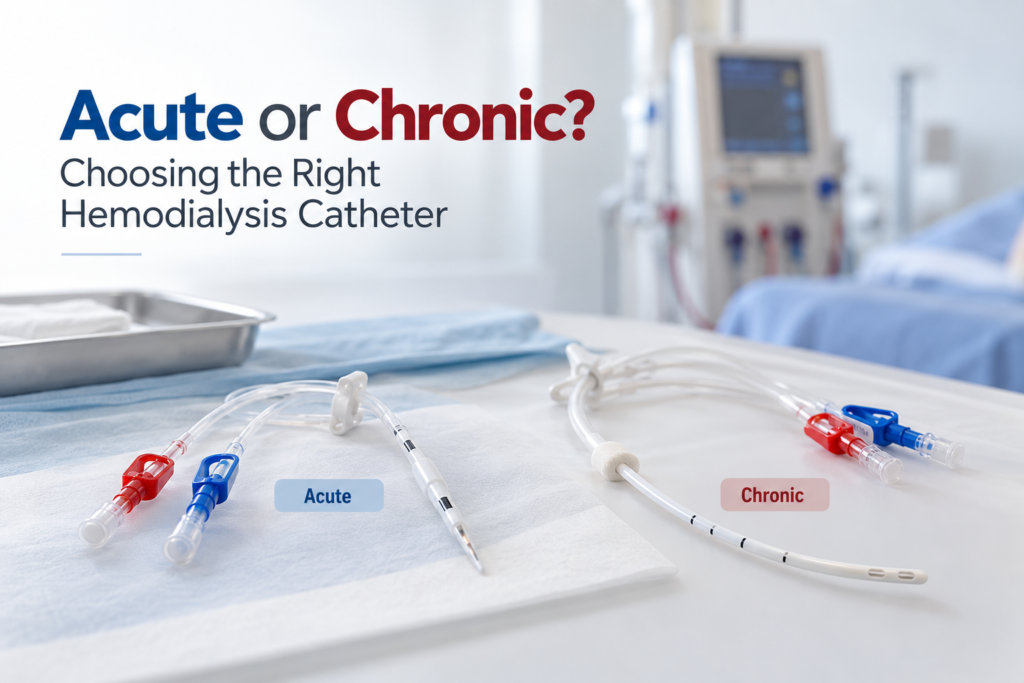
Every dialysis unit stocks two kinds of hemodialysis catheter: acute and chronic. They look similar on a tray, but they are built for different jobs. Picking the right one comes down to how long the patient will need access, where it goes in, and how much flow the treatment needs.
Acute catheters: fast access for short-term dialysis
An acute catheter is placed when a patient needs dialysis now, often in the ICU or emergency setting. It goes in at the bedside, usually through the jugular, subclavian or femoral vein, and is meant for short-term use.
The Dura Flow Acute Hemodialysis Catheter is a good example of what to look for:
- Flow: an 11.5F double-D lumen gives up to 300 ml/min at low arterial pressure.
- Material: thermosensitive polyurethane that is firm for insertion and softens at body temperature.
- Insertion kit: a step Teflon dilator (8F, 10F, 12F) replaces separate dilators, and a guide wire advancer lets you feed the wire with one hand.
- Extensions: clear silicone, in curved or straight versions.
For patients who also need infusions, blood sampling or CVP monitoring, a triple lumen version adds a 19G central lumen, so a second line is not needed. Pediatric sizes start at 6.5F x 8 cm.
Chronic catheters: tunnelled access for longer treatment
When a patient needs dialysis for weeks or months, or is waiting for a fistula to mature, a chronic catheter is the usual choice. It is tunnelled under the skin and has a cuff that the tissue grows into, which holds it in place and helps keep infection out.
Tip design matters most here, because it affects flow and recirculation:
- Symmetric tip (Harmony): both lumens end at the same point with side holes, which keeps recirculation low. It is made of 14.5F carbothane and rated for flow rates up to 400 ml/min.
- Stagger tip (Maxima): the two lumens end at different points. It is rated for more than 400 ml/min, comes in straight and pre-curved versions, and is MRI compatible.
- Over-the-wire placement (Dura Guide): a pre-loaded PTFE stylet stiffens the catheter so it can be placed directly over the guide wire.
Matching length to the insertion site
Catheter length follows the vein. As a general guide from Meditech’s ordering tables:
| Catheter length | Tip to cuff | Usual site |
| 24 cm | 19 cm | Right jugular vein |
| 28 cm | 23 cm | Left jugular vein |
| 36 cm and longer | 31 cm and longer | Femoral vein |
Pediatric chronic catheters are available in 8F, 10F and 12.5F at 18 cm.
The short version
Short-term or emergency access calls for an acute catheter. Longer treatment calls for a tunnelled, cuffed chronic catheter, with the tip design chosen for the flow and recirculation the unit needs. The final choice always rests with the treating clinician.
To check sizes and codes, see our nephrology range or contact our team for a quote.
More to read
French and Gauge Sizes Explained
Open any medical device catalogue and you will see sizes like 6F, 14.5F, 18G or 0.035”. They look similar, but they work in opposite…
Read article French and Gauge Sizes Explained
Polyurethane or Silicone? A Practical Guide to Double J Stents
A Double J stent keeps urine draining from the kidney to the bladder after stone surgery, ureteroscopy or a blockage. The basic shape is…
Read article Polyurethane or Silicone? A Practical Guide to Double J StentsHave a question about our products?
Our team will help you choose the right device for your hospital or distribution network.