
French and Gauge Sizes Explained
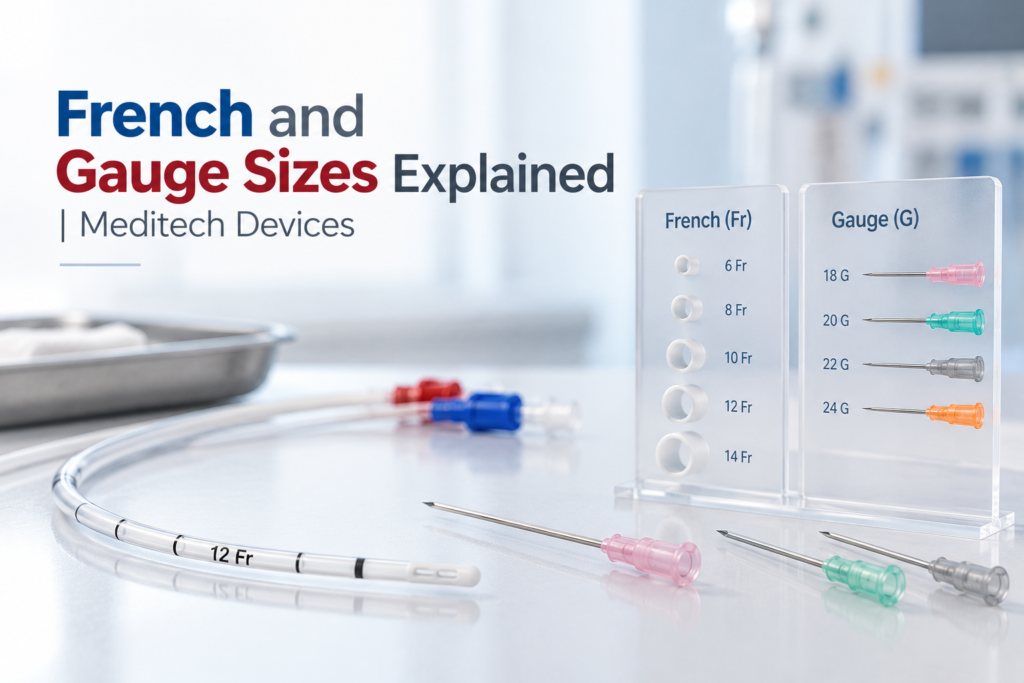
Open any medical device catalogue and you will see sizes like 6F, 14.5F, 18G or 0.035”. They look similar, but they work in opposite directions. Mixing them up is one of the most common ordering mistakes. Here is how to read them.
French (F or Fr): bigger number, wider tube
The French scale measures the outer diameter of catheters, stents, drains and dilators. The rule is simple:
1 French = 1/3 mm, so the diameter in mm = French size ÷ 3.
| French size | Outer diameter | Example from our range |
| 3F | 1.0 mm | Smallest Double J stent |
| 6F | 2.0 mm | Double J stent, ureteral catheter |
| 8F | 2.7 mm | Pigtail drainage catheter |
| 11.5F | 3.8 mm | Dura Flow acute dialysis catheter |
| 14.5F | 4.8 mm | Harmony and Maxima chronic catheters |
| 24F | 8.0 mm | Amplatz sheath, Foley catheter |
Some products carry two French sizes, such as a 7F/14F endopyelotomy stent. That means the stent is 7F along most of its length and widens to 14F at one end.
For sheaths and introducers, the French size usually describes what fits through them, not their outside. A 24F Amplatz sheath accepts a 24F instrument.
Gauge (G): bigger number, thinner needle
Gauge is used for needles, and it runs the other way. A higher gauge means a thinner needle. An 18G needle is wider than a 22G needle.
There is no simple formula for gauge, so a table is the easiest way to read it. These are approximate outer diameters:
| Gauge | Outer diameter | Example from our range |
| 11G | 3.0 mm | Bone marrow biopsy needle |
| 14G | 2.1 mm | Medi Core biopsy instrument |
| 18G | 1.2 mm | Introducer needle, biopsy needle |
| 20G | 0.9 mm | Arterial catheter, biopsy needle |
| 22G | 0.7 mm | Huber needle, Chiba needle |
| 25G | 0.5 mm | Spinal needle |
This is also why a coaxial needle has a lower gauge number than the biopsy needle that passes through it. A 14G biopsy needle runs through a 13G coaxial needle, which is slightly wider.
Guide wires: inches
Guide wires are usually sized in inches of diameter, with the length in centimetres:
- 018” = 0.46 mm
- 025” = 0.64 mm
- 035” = 0.89 mm
- 038” = 0.97 mm
A product page will often say which wire it accepts. For example, our introducer needles and PCN dilators accept a 0.038” guide wire.
A quick way to remember
- French: catheters and tubes. Bigger number, wider.
- Gauge: Bigger number, thinner.
- Inches: guide wires. Check the wire matches the needle or dilator it goes through.
If you are unsure which size to order, send us the product code or the size you use today and our team will help you match it.
More to read

Polyurethane or Silicone? A Practical Guide to Double J Stents
A Double J stent keeps urine draining from the kidney to the bladder after stone surgery, ureteroscopy or a blockage. The basic shape is…
Read article Polyurethane or Silicone? A Practical Guide to Double J Stents
Acute or Chronic? Choosing the Right Hemodialysis Catheter
Every dialysis unit stocks two kinds of hemodialysis catheter: acute and chronic. They look similar on a tray, but they are built for different…
Read article Acute or Chronic? Choosing the Right Hemodialysis CatheterHave a question about our products?
Our team will help you choose the right device for your hospital or distribution network.